

Drones have become one of the most exciting innovations in modern aviation. While many people associate drones with aerial photography and recreational flying, today’s unmanned aircraft are supporting industries such as agriculture, construction, emergency response, infrastructure inspection, and logistics.
The Federal Aviation Administration (FAA) refers to drones as Unmanned Aircraft Systems (UAS), a term that encompasses the aircraft itself as well as the systems used to control and communicate with it. As UAS technology continues to evolve, understanding the different types of drones provides insight into a rapidly growing segment of the aviation industry.
While drones can be categorized in several ways, aviation professionals commonly group them into four primary aircraft types: multi-rotor, fixed-wing, single-rotor, and hybrid vertical takeoff and landing (VTOL) systems.
Multi-Rotor Drones
Multi-rotor drones are the most widely used type of UAS. These aircraft use multiple rotors to generate lift, provide control, and maintain stability during flight. The most common configuration is the quadcopter, which uses four rotors, although some systems use six or eight rotors for increased lifting capability.
Because of their maneuverability and ability to hover, multi-rotor drones are popular across many industries.
Common Applications
- Aerial photography and videography
- Construction site monitoring
- Infrastructure inspections
- Public safety operations
- Real estate marketing
Multi-rotor drones are often the first aircraft new drone pilots learn to operate and remain the most recognizable type of drone in use today.

Fixed-Wing Drones
Fixed-wing drones resemble traditional airplanes and generate lift through their wings rather than relying solely on rotors. Unlike multi-rotor aircraft, fixed-wing drones must continue moving forward to remain airborne.
Their aerodynamic design allows them to fly longer distances and remain in the air for extended periods of time.
Common Applications
- Agricultural surveying
- Land mapping
- Environmental monitoring
- Pipeline inspections
- Utility corridor assessments
Because they can efficiently cover large areas, fixed-wing drones are commonly used for missions that require extensive data collection.

Single-Rotor Drones
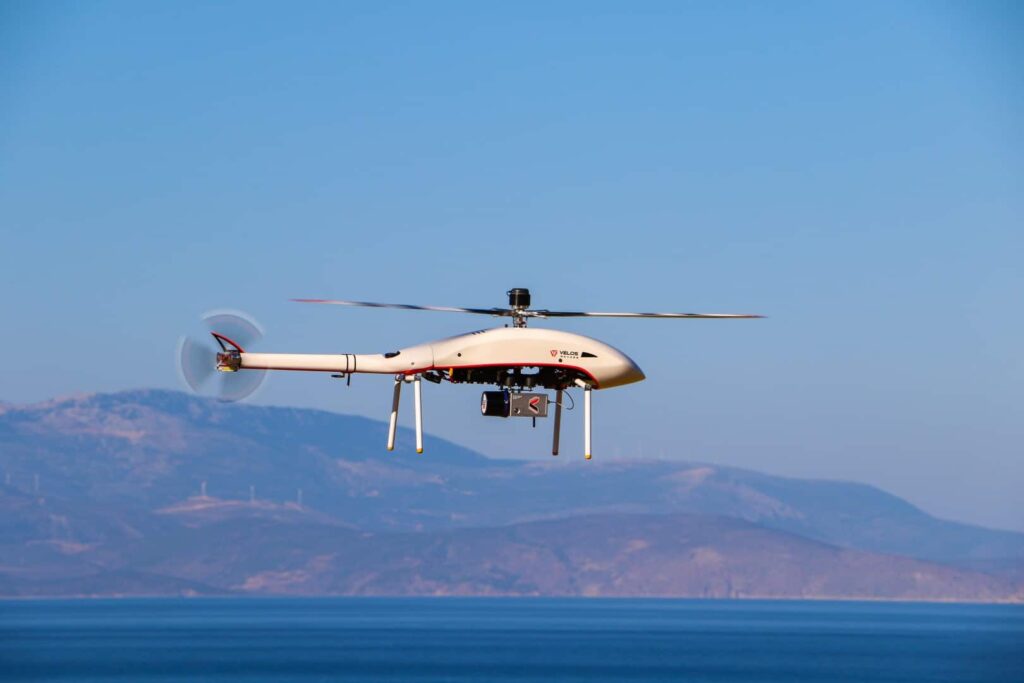
Single-rotor drones operate similarly to helicopters, utilizing one primary rotor and a smaller tail rotor for stability and control.
Although less common than multi-rotor aircraft, single-rotor drones can offer greater efficiency and higher payload capacities, making them valuable for specialized missions.
Common Applications
- Industrial inspections
- Research projects
- Specialized surveying operations
- Heavy-sensor deployments
These aircraft are typically used by organizations that require capabilities beyond what smaller multi-rotor platforms can provide.
Hybrid VTOL Drones
Hybrid VTOL drones combine characteristics of both multi-rotor and fixed-wing aircraft. They can take off and land vertically like a helicopter while transitioning to forward flight like an airplane.
This combination allows operators to launch from confined spaces while still benefiting from the extended range and efficiency of a fixed-wing aircraft.
Common Applications
- Long-range surveying
- Search and rescue missions
- Infrastructure inspections
- Environmental research
As UAS technology advances, hybrid VTOL systems are becoming increasingly popular for commercial and government operations.

Specialized Drone Applications
While aircraft design is one way to classify drones, many are also categorized by the industries they serve.
Agriculture
Agricultural drones help farmers monitor crop health, identify irrigation issues, create field maps, and support precision agriculture practices. These technologies allow operators to gather valuable information quickly and efficiently across large areas of farmland.
Infrastructure Inspection
Utilities, engineering firms, and construction companies use drones equipped with cameras and sensors to inspect bridges, power lines, cell towers, wind turbines, and industrial facilities. By collecting data from the air, organizations can often improve safety while reducing inspection times.
Emergency Response
Public safety agencies increasingly use drones to support search-and-rescue efforts, disaster response operations, and situational awareness during emergencies. Real-time aerial information can help first responders make informed decisions when time is critical.
Delivery Services
Several companies are actively testing and expanding drone delivery services for packages, medical supplies, and other essential goods in select locations. Although the technology is still developing, drone delivery continues to be an area of significant growth and innovation.
Career Opportunities in the Drone Industry
As organizations continue to adopt UAS technology, demand is growing for professionals who understand aviation, regulations, maintenance, and flight operations.
Career opportunities include:
- Drone Pilot
- UAS Operations Specialist
- Infrastructure Inspection Technician
- Agricultural Drone Operator
- Mapping and Surveying Technician
- Public Safety Drone Pilot
- UAS Program Manager
- Aviation Maintenance Technician supporting drone fleets
The continued growth of unmanned aviation is creating new opportunities for individuals interested in both technology and flight.
The Future of Unmanned Aviation
If learning about drones has sparked your interest in unmanned aviation, Hallmark University’s Associate of Applied Science in Unmanned Aerial Systems (UAS) program can help you take the next step. In this 14-month hybrid program, students gain hands-on experience with drone operations while preparing for FAA Part 107 certification.
Learn more about Hallmark University’s Unmanned Aerial Systems program and discover how you can prepare for a career in one of aviation’s fastest-growing fields.